

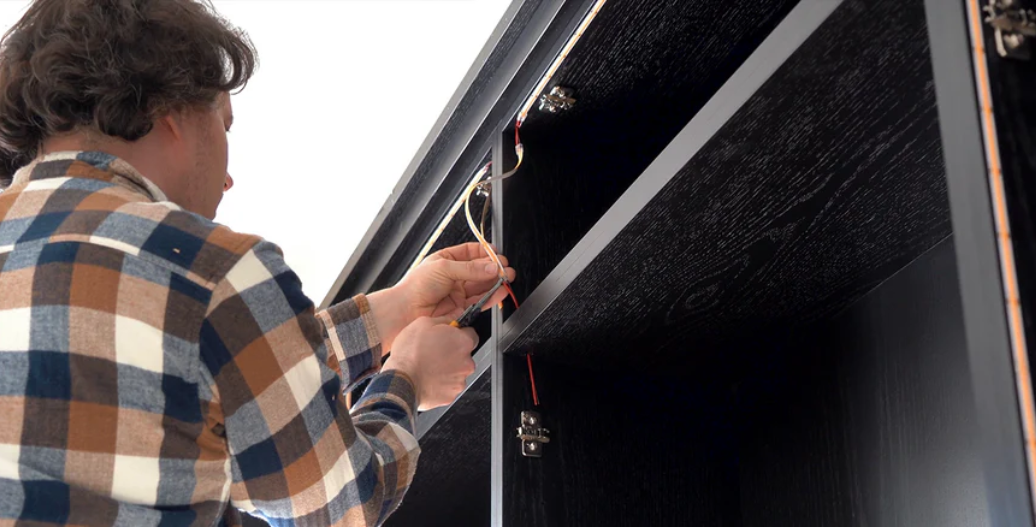

Low-voltage LED lighting has changed what's possible in residential and commercial spaces. Strip lights tuck into coves and toe-kicks, light sheets illuminate countertops and architectural features, and entire lighting systems can operate safely and efficiently on low-voltage power. But there is a quiet trap built into how well this technology performs: it works so well, and for so long, that people forget it will eventually need service.
Power supplies get buried in walls. Controllers are hidden behind finished surfaces. LED strips are installed where they can never be reached again. In the worst cases, lighting is permanently encased in epoxy, concrete, or millwork. Then five, eight, or twelve years later, a component fails, and the only way to replace a relatively inexpensive part is to demolish part of the installation.
This article is about avoiding that mistake. Whether you're a licensed electrician wiring a custom home or a homeowner planning your first lighting project, the single most valuable feature you can build into a low-voltage lighting system is serviceability.
The Mindset: Plan the Replacement Before the Installation
A quality LED strip may be rated for 50,000 hours or more, but that does not make it permanent. LEDs gradually lose output over time. Solder joints experience thermal cycling. Adhesives can degrade in demanding environments.
Most importantly, the power supply is often the first component to fail.
Power supplies contain electronic components that naturally age over time, particularly when exposed to elevated temperatures. In many lighting systems, the LEDs continue operating long after the power supply reaches the end of its service life. Controllers, dimmers, wireless receivers, and other electronic control devices can also fail before the lighting itself.
The real question is not whether you'll need to service the system someday. It's how difficult that service will be when the time comes.
The solution is simple: every component should be replaceable without destroying the surrounding construction.
Before installation, ask yourself:
- How would I replace the power supply?
- How would I replace the controller?
- How would I replace the LED strip?
- How would I replace a connector or wire run?
If you cannot answer those questions, the design probably needs more thought.
The Code Already Supports This Approach
Serviceability is not just a best practice. Accessibility is a recurring theme throughout the National Electrical Code and many product listing requirements.
Low-voltage lighting systems fall under several NEC articles depending on the system design, voltage, power source, and installation method. While specific requirements vary, the code consistently recognizes the need for equipment to remain accessible for inspection, maintenance, replacement, and safe servicing.
Power supplies, controllers, junctions, and disconnecting means should not be installed in locations that require demolition or removal of permanent building finishes to access them.
Even when a specific installation does not explicitly require future servicing, designing for accessibility makes maintenance safer, easier, and far less expensive.
The Power Supply Location Is One of the Most Important Design Decisions
Because the power supply is often the most likely component to require replacement, its location deserves careful planning.
Install power supplies in locations that can be reached without opening walls, removing stonework, or disassembling cabinetry. Common serviceable locations include:
- Accessible cabinets
- Utility rooms
- Mechanical spaces
- Accessible attics or crawlspaces
- Junction boxes with removable covers
- Purpose-built access panels
Avoid permanently concealing power supplies behind drywall, tile, stone, millwork, or other finished surfaces.
One effective approach is to centralize power supplies in an accessible location and run low-voltage wiring to each lighting zone. This makes future maintenance much easier because all power supplies can be inspected and replaced from a single service location.
When using remote power supply locations, be sure to account for voltage drop. Longer wire runs may require larger wire sizes or different system layouts to maintain proper voltage at the fixture.
Label every power supply with the lighting zone it serves, the output voltage, and the installation date. The person servicing the system ten years from now will appreciate it.
Conduits, Access Panels, and the Anti-Burial Rule
Whenever you're about to make a low-voltage lighting component permanent, stop and ask whether it can still be serviced in the future.
For LED strips installed in aluminum channel, the channel itself often provides a serviceable pathway. An LED strip installed in an accessible channel is generally much easier to replace than one adhered directly to a finished surface with no means of access.
The same principle applies to wiring. Where practical, consider installing low-voltage wiring in conduit or other accessible pathways, especially in locations where future wire replacement would otherwise require opening finished walls or ceilings.
The biggest mistakes occur when lighting becomes permanently trapped inside the architecture.
For under-cabinet and countertop applications using LED light sheets, coordinate with the countertop fabricator and installer to ensure the lighting system remains accessible for future service or replacement. A small amount of planning during fabrication can prevent major reconstruction later.
For epoxy installations, avoid embedding LED strips, power supplies, controllers, or connections directly into the finished surface. If an LED strip is permanently encased in epoxy, assume the entire installation becomes non-serviceable. Future repairs may require replacing the countertop, bar top, display feature, or architectural element itself.
The same principle applies to concrete installations. Design the system so lighting components, wiring, and connections remain accessible for inspection, maintenance, and replacement whenever possible.
If a component cannot be reached, it cannot be serviced.
Connectors and the Small Details That Simplify Repairs
Serviceability often comes down to small decisions.
Whenever practical, use connectors and connection methods that allow future access and replacement. Leave service loops with a few extra inches of wire at fixtures, controllers, and power supplies. That extra slack can make the difference between a simple repair and a complete rewire.
Document the installation before it disappears behind finished surfaces.
A few photos showing wire routes, power supply locations, controller locations, and product labels can save hours of troubleshooting years later. Keep records of part numbers, wiring layouts, and system voltages.
Documentation is one of the least expensive serviceability tools available.
Service is Forever
The best lighting installations disappear into the architecture. They illuminate the space beautifully and perform reliably for years, but every lighting system will eventually need attention. A power supply may fail. A controller may stop communicating. An LED strip may reach the end of its useful life.
The difference between a quick repair and a costly renovation comes down to decisions made during installation. Plan where the power supply will live before you mount it. Provide access to controllers and connections. Use conduit or accessible pathways where future replacement may be necessary. Add an access panel where it can save a wall from being opened years later.
LEDs last a long time. Service lasts forever.
Want More Tips Like This?
Our Pro Program is built for contractors, electricians, builders, and lighting professionals who want to install with confidence. Members get access to exclusive pricing, expert support, and practical resources that help you build better lighting systems from day one through every future service call.


