

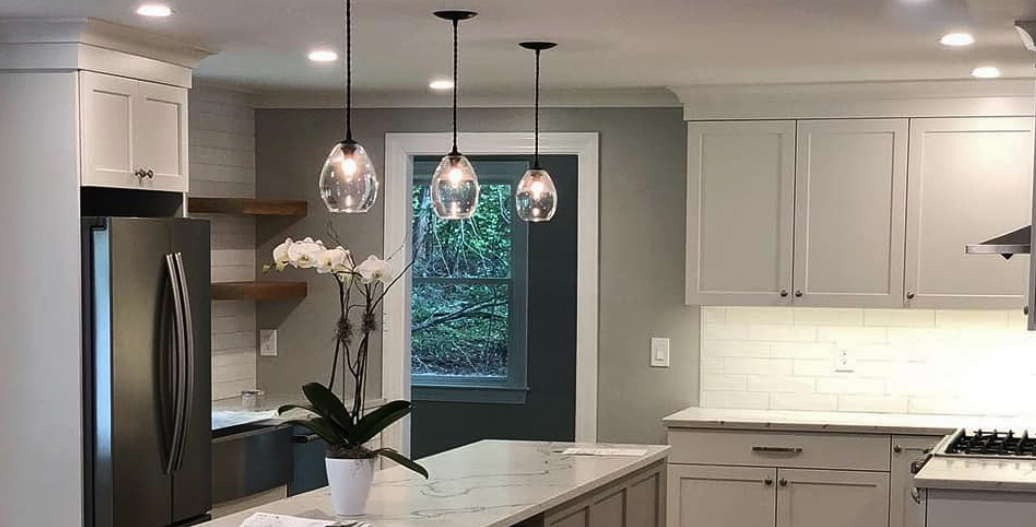

Good lighting design doesn't always mean using the same fixture everywhere. LED strip lights are great for smooth, continuous illumination, while LED puck lights provide focused light in smaller or harder-to-reach spaces. In many projects, using both can give you the best of both worlds.
So, can you mix LED puck lights and LED strip lights?
Yes, but there are a few important things to consider. Voltage, color temperature, power supply sizing, dimming, and controls can all affect how well they work together.
Here's what to know before you connect them.
Where Can You Use Puck Lights and Strip Lights Together?
Puck lights and strip lights each have their strengths, making them a great combination for applications such as:
- Kitchen cabinets: Use strip lights for continuous under-cabinet lighting and puck lights inside cabinets or in tight corners.
- Display cases and shelving: Use puck lights for focused illumination and strip lights along shelves or cabinet edges.
- Closets and niches: Strip lights work well along shelves and rods, while puck lights can fill smaller spaces.
- Accent lighting: Combine the two to create both ambient and focused illumination.
The goal isn't to make every fixture the same. It's to use each type where it works best.
Can LED Puck Lights and Strip Lights Use the Same Power Supply?
Yes, if you are not dimming or only if you are dimming on the low voltage DC side and you have separate controllers for each type of light, they can often share a power supply if they operate at the same voltage and the power supply is properly sized for the total load.
Most low-voltage LED puck lights and strip lights operate at either 12V or 24V DC.
Before connecting them, make sure:
- Both products use the same voltage
- The power supply can handle the combined wattage
- The wiring is properly sized for the load and run length
- All components are compatible with the installation
For example, 24V LED strip lights and 24V LED puck lights can potentially run from the same 24V power supply.

Just because they can share a power supply doesn't mean they should share a dimmer.
Should Puck Lights and Strip Lights Be on the Same Dimmer?
No. We recommend using separate dimming zones.
Puck lights and strip lights have different drivers and electrical characteristics. As a result, they will respond differently to the same dimming signal.
On a shared dimmer, you could see:
- One fixture type dim faster than the other
- Different brightness levels at the same dimmer setting
- Flickering at low levels
- One fixture turning off before the other
These differences can be especially noticeable when the lights are dimmed very low.
The best approach is to give each fixture type its own dimming zone. They can still be controlled through the same overall system, but each type can be adjusted independently.

If you are using dimmable power supplies, you should use a separate dimmable power supply for each type of light.

Do Puck Lights and Strip Lights Need to Match Color Temperature?
If you want the lighting to look consistent, matching the color temperature is important.
Color temperature, or CCT, describes how warm or cool the light appears:
- 2700K–3000K: Warm white
- 4000K: Neutral white
- 6000K: Cool white
For example, pairing 3000K puck lights with 3000K strip lights will generally create a more cohesive look than mixing 3000K and 4000K.
Even when the listed CCT is the same, different products can have slight variations in appearance. If color consistency is critical, test the products together before installation.
Can You Mix 12V and 24V LED Lights?
No. 12V and 24V LED products should not be connected to the same power supply.
The LED products and power supply must operate at the same voltage.
Always check the product specifications before connecting multiple LED products to one power supply.
Don't Forget About Voltage Drop
Voltage drop is an important consideration in any low-voltage LED installation.
Longer wire runs, higher loads, and undersized conductors can increase voltage drop, which may result in:
- Reduced brightness
- Uneven light output
- Color inconsistencies
- Dimming issues
When combining puck lights and strip lights, consider the total load, wire size, wire length, and power supply location.
What Does the NEC Say About Mixing Puck Lights and LED Strip Lights?
Mixing fixture types isn't prohibited simply because one is a puck light and the other is LED strip light. However, the complete low-voltage system still needs to meet applicable electrical codes and manufacturer requirements.
Depending on the installation, NEC Article 411 and NEC Article 725 may apply.
Always:
- Use properly listed components
- Properly size the power supply
- Follow manufacturer installation requirements
- Account for voltage drop
- Verify applicable code requirements
When in doubt, have a qualified electrician review the installation.
Can Puck Lights and Strip Lights Use the Same Control System?
Yes, but not the same dimmer. They can be part of the same control system while operating on separate zones.
For example:
Zone 1: LED strip lights under the cabinets
Zone 2: LED puck lights inside the cabinets
Both can be controlled from the same wall control or remote while still allowing each fixture type to be adjusted independently.
This gives you the convenience of one control system without forcing different LED products to dim exactly the same way.
Design for the Light You Actually Need
The best lighting systems aren't always built around a single product. They're built around the space.
Use LED strip lights when you want smooth, continuous illumination. Use puck lights when you need focused light or have a space where strip lighting isn't practical. And when you need both, don't be afraid to combine them.
Just match the voltage, size the power supply correctly, consider voltage drop and color temperature, and give different fixture types their own dimming zones.
When each fixture is doing what it does best, the result is a lighting system that looks intentional and performs the way it should.


