

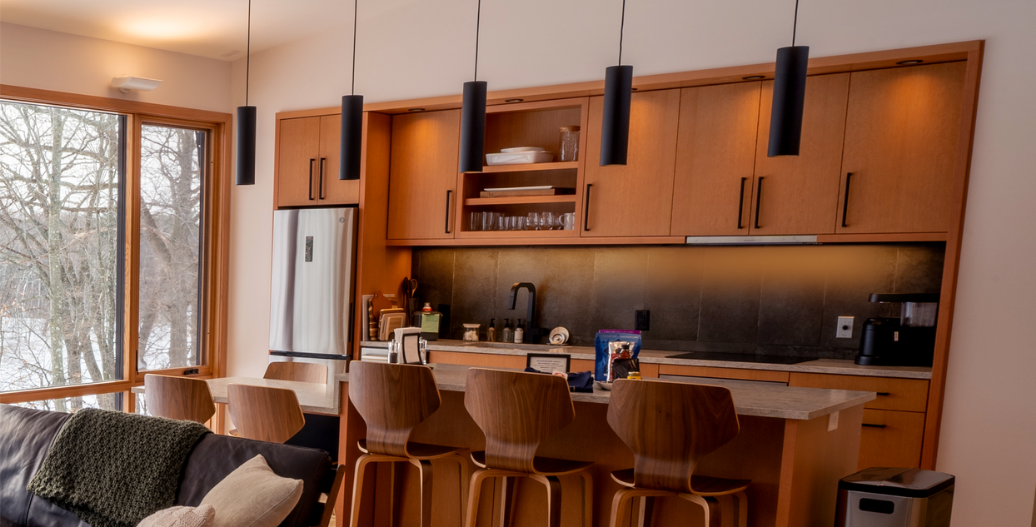

Many lighting projects start with the question, “How does this light look by itself?” instead of the more important question, “What is this light meant to do in the space?”
The goal of this article is to shift that mindset. Rather than selecting fixtures first, we will look at how a room, such as a living room, is actually used and then work backward to determine the right types of lighting, placement, and control.
The Three Types of Lighting Applications
From an application standpoint, residential lighting falls into three main categories:
- Ambient lighting provides general illumination for the room.
- Task lighting delivers focused light for specific activities like reading.
- Accent lighting adds depth, visual interest, and mood.
The most comfortable living rooms use all three layers together. Recessed lights often handle ambient and task lighting, while LED strip lighting is especially effective for accent applications.
Case Study: A Living Room with No Existing Lighting
Imagine a living room measuring 12 feet by 16 feet with no existing ceiling lights. This is common in older homes that relied on floor and table lamps instead of hardwired fixtures. There are no constraints and no existing lighting layout. You are starting with a blank slate.
Ambient Lighting and Recommended Light Levels
When people design a living room from scratch, overhead lighting is usually the first consideration.
According to general lighting guidance from the Illuminating Engineering Society (IES), living rooms fall within a 10 to 20 foot-candle range, with the expectation that lighting will be layered and controlled rather than uniformly bright.
For a 12 by 16 foot room, that translates to roughly 2,000 to 4,000 lumens of ambient light.
Our 4.75-inch Ultra-Thin recessed light delivers approximately 650 to 700 lumens per fixture, depending on color temperature and configuration. Based on that output, reaching the recommended ambient light range only requires about 6 to 8 recessed fixtures, not a full ceiling grid.
At this level, the room has sufficient general illumination without feeling overly bright or flat.
Why More Recessed Lights Is Not Always Better
It is easy to assume that evenly spacing recessed lights across the ceiling will create the best result. In reality, designing solely for maximum foot-candles often leads to a living room that feels harsh during everyday use.
Most living room activities do not require uniform brightness everywhere. Watching TV, relaxing, or talking with guests all benefit from softer, more layered lighting. This is why ambient lighting should be treated as a foundation, not the entire solution.
Using fewer recessed lights also gives you more flexibility when the lights are dimmed, which is how living rooms are actually used most of the time.
Task Lighting Where Light Is Needed
Task lighting allows you to increase light levels only where they serve a purpose.
Reading chairs, seating areas, and coffee tables can be supported with focused recessed lights, adjustable downlights, or lamps. aspectLED's 4.2-inch recessed light with a 15-degree beam angle can be used selectively as task lighting when placed intentionally over the task area and controlled with a separate dimmer.
This approach delivers higher light levels where needed without overwhelming the entire room.
Accent Lighting and the Feel of the Space
Accent lighting is what gives a living room its character.
Cove lighting, shelf lighting, wall accents, and lighting integrated into built-ins add depth without glare. LED strip lighting works especially well here because the light source itself is subtle while the effect is noticeable.
Accent lighting increases perceived brightness and comfort, often allowing ambient lighting levels to stay lower while the room still feels well lit.
Using Dimmers and Controls at Every Layer
No lighting plan is complete without proper control.
Ambient, task, and accent lighting should all be independently dimmable and controllable. This allows you to dial in the exact look you want for different activities and times of day.
With dimmers and lighting controllers, you can:
- Lower ambient lighting for everyday use
- Increase task lighting when reading
- Use accent lighting alone for a relaxed atmosphere
- Adjust all layers together when entertaining
Lighting design is not just about fixtures. It is about how those fixtures are controlled. When each layer can be adjusted independently, the space becomes far more flexible and comfortable.
Key Takeaway: Design for Use, Not Maximum Brightness
A space, such as a living room, does not need to be at maximum brightness all the time. It needs options.
Rather than filling the ceiling with recessed lights to hit the highest foot-candle recommendation, a better approach is to:
- Use overhead lighting for ambient coverage
- Add task lighting where higher light levels are needed
- Layer in accent lighting to shape the mood
- Control every layer with dimmers and lighting controls
When lighting is designed around how a space is actually used, the result is a space that feels intentional, comfortable, and adaptable, illuminated with purpose rather than just bright.


