


A DMX decoder with XLR ports is an essential component for integrating LED lighting into professional DMX control systems. These versatile devices bridge the gap between traditional DMX lighting equipment and modern LED strip installations, offering flexibility for a variety of applications.
Understanding DMX Decoder Options
DMX decoders with XLR ports are available in both 3-channel and 4-channel configurations. The 4-channel version provides enhanced functionality for RGBW applications, allowing independent control of red, green, blue, and white channels. This expanded capability delivers greater creative control over lighting effects and color mixing.
Connection and Wiring
The wiring configuration follows a straightforward approach. On the input side, the decoder requires a power supply connection with clearly labeled V(+) and V(-). The output side features channel terminals (either 3 or 4 depending on the model) that connect directly to the LED Strip Lights.
What distinguishes these decoders from standard models is the signal input options. While they maintain compatibility with standard RJ45 connections for DMX signal input, they also feature professional XLR ports. RJ45 stands for “Registered Jake 45” and is an 8-contact/position plug commonly used to connect to ethernet-based local area networks such as computers or routers. An XLR port is a cylindrical connector with 3-7 pins, commonly used in professional audio and video equipment. This dual-input capability provides significant flexibility for integration with existing DMX systems, making them particularly valuable for professional lighting installations.
Setting DMX Addresses
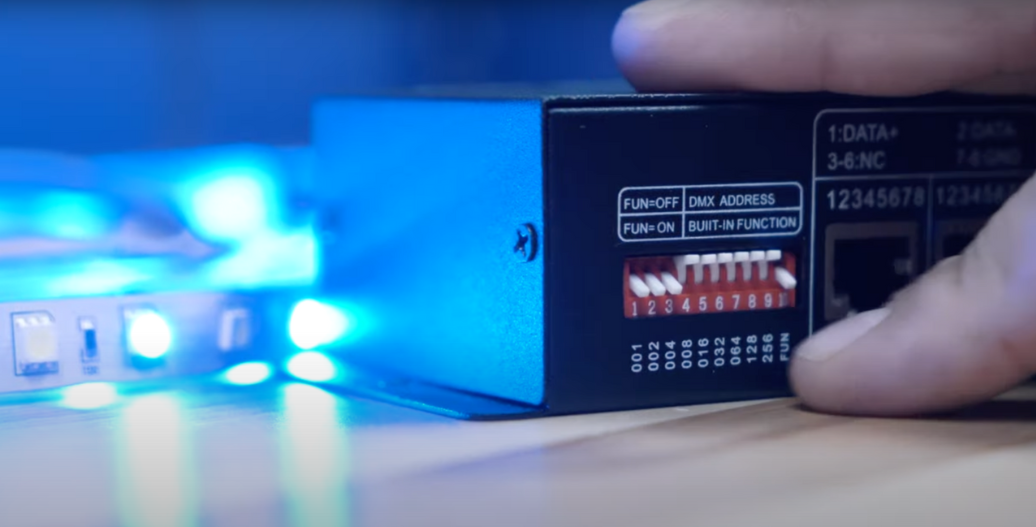
Unlike decoders with digital displays, these models utilize Dual In-line Package (DIP) switches for address configuration. A DIP switch is a small switch used to configure electronic devices. This approach may initially seem complex, as the limited number of switches must accommodate the full range of 512 DMX addresses. However, the process is simplified using DMX apps readily available online. These apps function similarly across platforms - simply search for "DMX calculator" or "DMX app" on the internet, input your desired address, and the app will display the exact DIP switch configuration needed.
To set a DMX address:
Unlike decoders with digital displays, these models utilize Dual In-line Package (DIP) switches for address configuration. A DIP switch is a small switch used to configure electronic devices. This approach may initially seem complex, as the limited number of switches must accommodate the full range of 512 DMX addresses. However, the process is simplified using DMX apps readily available online. These apps function similarly across platforms - simply search for "DMX calculator" or "DMX app" on the internet, input your desired address, and the app will display the exact DIP switch configuration needed.
To set a DMX address:
- 1. Ensure the function switch is in the OFF position
- 2. Determine the desired DMX address (example: address 62)
- 3. Use a DMX address calculator application to determine the correct DIP switch configuration
- 4. Adjust the DIP switches to match the indicated pattern (for address 62: first switch down, last three switches down)
Built-in Function Modes
When operating independently from DMX control, these decoders offer preset functions by activating the function switch:
With the function switch in the ON position:
- Switch 1: Preset red
- Switch 2: Preset green
- Switch 3: Preset blue
- Switch 4: Preset yellow
- Switch 5: Preset magenta
- Switch 6: Preset cyan
- Switch 7: White (RGBW strips only)
- Switch 8: Color clipping pattern
- Switch 9: Color panning program
These preset functions provide immediate lighting effects without requiring a DMX controller, offering versatility for testing or standalone applications
Applications and Advantages of DMX Decoders
The integration of XLR ports into these DMX decoders delivers significant advantages for professional lighting environments. Theater installations, entertainment venues, and architectural lighting systems typically utilize XLR-based DMX infrastructure. These decoders enable seamless integration of LED strip lighting into these existing systems without requiring additional adapters or signal converters.
The dual-input design also provides redundancy options, allowing for both RJ45 and XLR signal paths in critical installations where system reliability is paramount.
If you want to watch the video on this topic, check it out here:


