

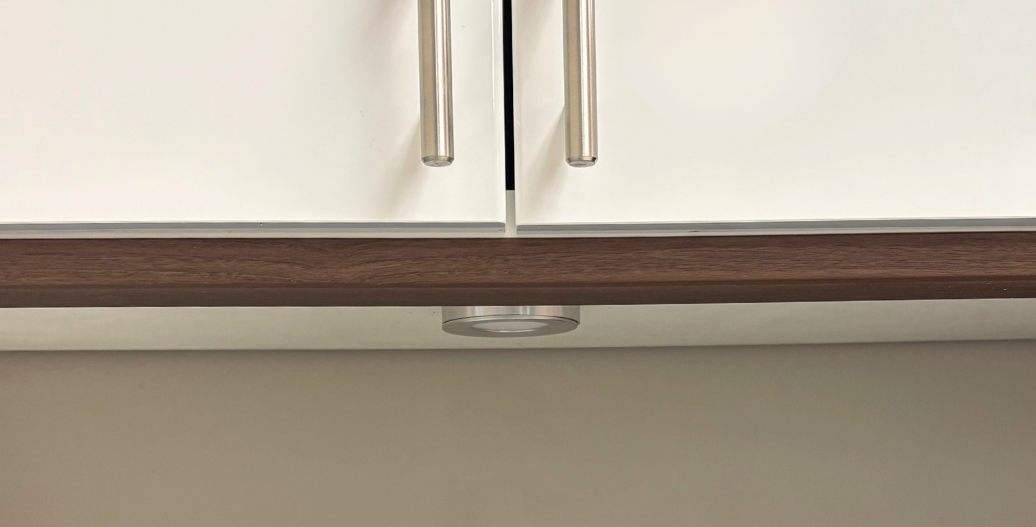

Under-cabinet puck lights can make a big difference in your kitchen. They brighten countertops for food prep, help illuminate your coffee station, and add a warm glow to your space. But to get the best results, you need to know where to place them.
Space your puck lights too far apart, and you may notice dark gaps between fixtures. Place them too close together, and you could end up with more brightness than you need.
The good news? You don't need complicated calculations to plan your layout. With the right spacing guidelines, you can get a good idea of how far apart to install your lights before drilling any holes.
How Far Apart Should Under-Cabinet Puck Lights Be?
A helpful starting point is to space your puck lights approximately the same distance apart as they are from the countertop. This is often called the 1:1 spacing rule.
For example, if your puck lights are 12 inches above the countertop, start by spacing them about 12 inches apart, measured from the center of one light to the center of the next.
The ideal spacing depends on your fixture's beam angle, light output, and mounting height. The wider the beam spreads, the farther apart you may be able to position your lights while maintaining good coverage.
LED Puck Light Spacing Chart
The chart below shows recommended center-to-center spacing and estimated surface brightness for a 2.75-inch Round Diffused Puck Light. This fixture produces 250 lumens, uses 3 watts, and has a 120° beam angle.
Use the chart to find a starting point based on the distance between your puck lights and the countertop. These are approximations. The material surfaces can distort the outcome.

FC stands for foot-candles, a measurement of how much light reaches a surface. These brightness values are estimates, not guaranteed results for every installation.
What does this mean for your kitchen?
- Lights closer to the countertop: You can expect brighter illumination in a smaller area, so closer spacing may help maintain consistent coverage.
- Lights farther from the countertop: The light spreads over a larger area, allowing for wider spacing, but the illumination on the countertop decreases.
- For everyday task lighting: Aim for overlapping light coverage to minimize distracting dark gaps and concentrated bright spots.
Keep in mind that the chart is specific to this puck light's 120° beam angle and 250-lumen output. Different fixtures may require different spacing.
How to Use the Chart for Your Project
Let's say you're installing puck lights underneath your kitchen cabinets to illuminate the countertop where you prepare meals.
Step 1: Measure the distance to your countertop.
Measure from the light-emitting surface of the puck light to the countertop. Don't measure the height of the puck itself or the entire cabinet.
Step 2: Find your measurement in the chart.
If the lights will sit 18 inches above the countertop, the chart suggests approximately 17.8 inches between the centers of adjacent fixtures.
Step 3: Plan your fixture locations.
Measure along the underside of your cabinets and mark each proposed light location. Consider where you need the most illumination, such as near your cutting board, sink, or coffee maker.
Step 4: Check your layout before installation.
If possible, test the lights in your proposed locations. Look for dark gaps, overly bright circles, and shadows along the front of the countertop. Adjust your layout as needed before making the installation permanent.
How Many Puck Lights Do You Need?
The number of puck lights depends on the length of your cabinets, your desired spacing, and where you want the light to land.
For example, imagine you have a 6-foot-long cabinet run and want to install seven puck lights.
- Cabinet run: 72 inches
- Number of puck lights: 7
- Spacing between fixture centers: 10 inches
- Distance from each end to the nearest fixture center: 6 inches
This layout gives you six 10-inch spaces between the seven lights, plus 6 inches at each end.
This is an example of how to plan a layout, not a universal recommendation. Check the spacing chart for your fixture and mounting height to determine whether 10-inch spacing makes sense for your project.
If your countertop includes a sink, cooktop, or corner, you may want to adjust the locations to prioritize the areas where you work most.
Common Puck Light Spacing Mistakes to Avoid
Even with a spacing chart, a few common mistakes can affect the finished result.
Placing lights too far apart. Large gaps between fixtures can create uneven illumination. Use the chart as a starting point and check how the beams overlap.
Ignoring the countertop. Your goal is to light the work surface, not simply distribute fixtures evenly under the cabinets. Consider where you chop vegetables, prepare coffee, and perform other daily tasks.
Assuming brighter lights will fix every dark spot. More lumens won't necessarily eliminate gaps in coverage. Adjusting fixture spacing or selecting a different beam angle may be more effective.
Forgetting about shadows. The position of your fixtures affects where shadows fall. If your puck lights are too far back toward the backsplash, you may cast shadows on the front of the countertop while working.
Mixing color temperatures. Choose matching color temperatures for a consistent appearance across your countertop. The 2.75-inch Round Diffused Puck Lights are available in 2700K, 3000K, 4000K, and 6000K options. The 2.75-inch Round Classic Low Voltage Puck Lights are available in 3000K, 4000K, and 6000K options. The 3.15-inch Adjustable White Recessed Puck Light has a switch that allows you to select between 3000K Warm White, 4000K Cool White or 6000K Day White.
What Else Should You Consider Before Installing Puck Lights?
Spacing is important, but it isn't the only thing that affects your results.
- Brightness: Lumens measure the total light output of a fixture. Foot-candles measure the light reaching a surface. A higher lumen rating doesn't automatically guarantee better countertop coverage.
- Diffusion: Diffused puck lights help soften the appearance of the light source and create a more comfortable lighting effect.
- Dimming: If you want brighter light for cooking and softer light in the evening, check that your puck lights, power supply, and dimmer are compatible.
- Wiring and power: Confirm the required voltage, power supply capacity, and wiring requirements before purchasing your fixtures. Follow the instructions and consult a qualified electrician if you're unsure about the electrical connections.
Frequently Asked Questions
Can I space LED puck lights 12 inches apart?
Yes, 12-inch spacing can work for many installations. For the 2.75-inch Round Diffused Puck Light, the spacing chart suggests approximately 12 inches when the light is 12 inches above the countertop. If your mounting height is different, use the corresponding chart measurement as your starting point.
Should puck lights be evenly spaced under cabinets?
Even spacing generally creates a more consistent appearance, but you may need to adjust the layout for sinks, corners, or other features. Prioritize the areas where you need the most light while maintaining good overall coverage.
Do puck lights need to overlap?
Overlapping light beams can help reduce dark gaps between fixtures. The amount of overlap depends on the beam angle, mounting height, and desired brightness. A spacing chart can help you plan, but testing the layout is the best way to evaluate the actual result.
What does center-to-center spacing mean?
Center-to-center spacing is the distance from the center of one puck light to the center of the next. It is not the distance between the edges of the fixtures.
Are LED puck lights good for under-cabinet task lighting?
Yes. LED puck lights are a useful option for illuminating kitchen countertops, coffee bars, and other work surfaces. Choose a fixture with suitable brightness and beam distribution, then plan the spacing to provide the coverage you need.
For linear under cabinet lighting, LED Light Bars would be a great option. With a sleek, low-profile design and preset lengths to choose from, they are an easy, go-to solution for any kitchen or task lighting project.
Find the Right Puck Light Layout for Your Home
Great under-cabinet lighting starts with a little planning. Measure the distance between your lights and countertop, use the spacing chart to plan your layout, and test the placement before making your installation permanent.
With the right fixture placement, you can create a kitchen that's brighter, more functional, and more inviting.
Explore LED puck lights to find lighting solutions for kitchen cabinets, coffee bars, display shelves, and other home projects.


