

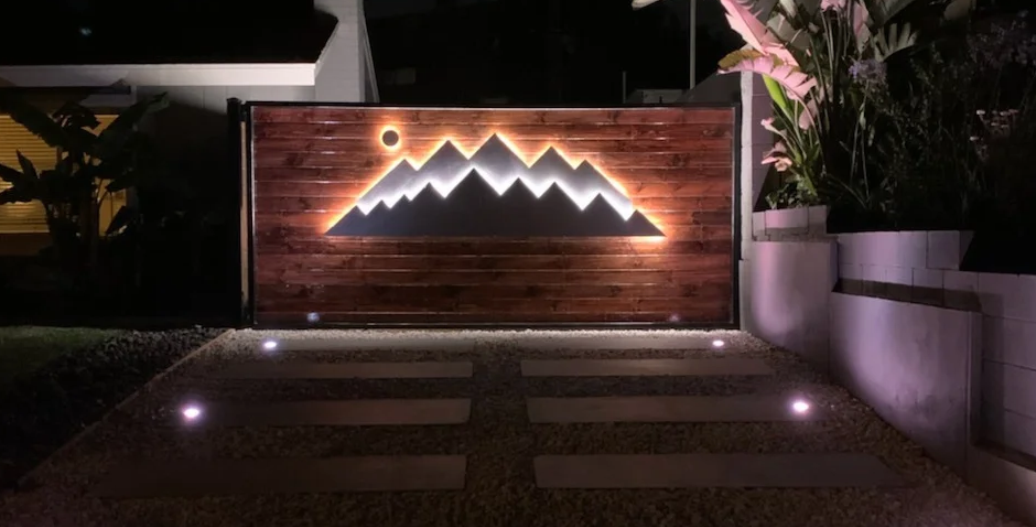

When should you use LED neon flex instead of LED strip lights? The answer comes down to how you want the light to look, where it will be installed and what the application requires.
LED neon flex is designed to be seen. Its silicone housing creates a smooth, continuous line of light that works well for signage, architectural outlines and decorative accents. LED strip lights offer more flexibility in how you build a lighting system, with options for task lighting, cove lighting, color-changing effects and installations where space is limited.
COB LED strip lights offer another advantage: a dotless appearance in a low-profile format. And for applications where a specific performance characteristic matters, the right strip light technology can make a difference.
Here's how to compare the options and choose the right lighting solution for your project.
What makes them different?
LED neon flex and LED strip lights both use low-voltage LED technology, but they are designed for different applications.
LED neon flex houses the light source inside a flexible silicone jacket that diffuses the light into a continuous, uniform line. Unlike traditional LED strip lights, neon flex has its diffuser built in, so it can create a finished appearance without a separate aluminum channel and diffuser lens.
We offer Element Neon Wide TopFlex and Element Neon SideFlex, along with color-changing and addressable options. The bend direction determines how the light can follow a shape or outline.
COB LED strip lights use chip-on-board technology, with LED chips mounted directly onto a flexible circuit board. A continuous phosphor coating creates a smooth, dotless line of light without requiring a thick neon-style housing. COB strips are well suited to under-cabinet lighting, coves, displays and other applications where a clean line of light needs to fit into a compact space.
Other LED strip light technologies, including CSP and SMD where specified, offer additional options for brightness, color, run length and installation requirements. The right choice depends on the specifications of the particular strip, not just the technology name.
Explore LED neon flex and LED strip lights to compare available configurations.
LED neon flex vs. LED strip lights: Side-by-side comparison
 |
 |
 |
|
| Feature |
LED neon flex |
COB LED strip lights |
Other LED strip lights, including applicable CSP and SMD options |
|
Primary application |
Signage, outlines and decorative accents | Dotless task, cove and accent lighting | Task, accent, cove and application-specific lighting |
|
Appearance |
Continuous, diffused line of light | Continuous, dotless line of light | Depends on LED package, spacing and any added diffuser |
|
Brightness |
Moderate output for decorative applications; check the individual product | Output varies by product and is suited to many architectural applications | Output varies by product and configuration |
|
Bend direction |
Top bend or side bend, depending on profile | Flexible in the plane of the strip; follow the product's bend limits | Flexible in the plane of the strip; follow the product's bend limits |
|
Profile and mounting |
Integrated silicone diffuser; mounting clips or compatible channel | Low-profile strip; an aluminum channel can add protection and diffusion | Low-profile strip; mounting requirements depend on the product |
|
Outdoor use |
aspectLED neon flex is IP67 rated | Depends on the specific strip's IP rating (IP65 to IP68) | Depends on the specific strip's IP rating (IP65 to IP68) |
| Color options | Static white, RGB and select addressable options | Available options depend on the product | Options may include static white, tunable white, RGB, RGBW and addressable |
| Cutting and customization | Cut at marked points and use compatible connectors, caps and accessories | Cut at designated points; soldering or compatible connectors may be used | Follow the product's designated cut points and connection requirements (unless you're using Free Cut) |
Product specifications vary by SKU. Confirm voltage, wattage, lumen output, maximum run length, cut increments, bend limits and IP rating before specifying a product.
5 reasons to choose LED neon flex

LED neon flex is a strong choice when the light itself is part of the design. Its built-in diffuser, flexible housing and purpose-built profiles make it especially useful for visible lighting features.
1. Create a continuous, dotless line of light.
Neon flex is designed to be looked at, not just looked with. Its silicone housing diffuses the light to create a smooth, uniform appearance without exposed LED points.
That makes it a natural fit for signage, architectural accents and decorative features where the light source is visible. Traditional LED strip lights can also achieve a dotless appearance, particularly COB strips or strip lights installed in a compatible frosted channel, but neon flex integrates the diffuser into the fixture itself.
2. Choose the right bend direction for your design.
Not every curve is the same. aspectLED neon flex comes in two primary bend directions:
- Top bend: Bends vertically, making it suitable for waves, flowing curves and architectural accents that follow changes in elevation.
- Side bend: Bends horizontally, making it suitable for outlines, edges, lettering and shapes that turn left or right along a surface.
Choosing the correct profile before installation helps avoid forcing the product into a shape it was not designed to follow. Check the specific product's minimum bend radius before planning tight curves.
3. Get a finished appearance without a separate diffuser.
Because the silicone jacket diffuses the light, neon flex does not require a separate aluminum channel and diffuser lens to create its characteristic appearance.
Mounting clips and brackets can secure the run, while a compatible mounting channel can provide additional support when the lighting needs to follow a particular shape or maintain a clean, aligned edge.
This can simplify installations where a visible, continuous line of light is the goal.
4. Find an option for outdoor applications.
aspectLED neon flex products are rated IP67, making them suitable for many outdoor applications, including architectural outlines, exterior signage and decorative features exposed to rain and spray.
The IP rating applies to the lighting product under its specified conditions. Power supplies, connections and other components must also be appropriate for the installation environment.
5. Add color and dynamic lighting effects.
Neon flex is available in more than static white. Depending on the product, you can choose RGB color-changing lighting or addressable RGB for dynamic effects.
For example, Borealis Neon SideFlex Light offers addressable RGB lighting. This can be useful for branded spaces, entertainment areas and architectural features where color and animation are part of the design.
5 reasons to choose COB or other LED strip lights

When the goal is to integrate lighting into a project rather than make the fixture itself a focal point, LED strip lights offer a wide range of options. COB technology is particularly useful when a smooth, dotless appearance is important.
1. Get a dotless appearance in a compact profile.
COB LED strip lights create a continuous line of light without the visible points associated with many conventional SMD LED strips.
Because the light source is integrated into a low-profile flexible circuit board rather than enclosed in a thick neon jacket, COB strips can fit into applications where available space is limited.
For installations where the strip will be visible, such as beneath cabinets or along shelving, COB strips can provide a clean appearance without the added height of neon flex.
2. Choose output to match the application.
LED strip lights are available in a range of outputs and configurations. For functional lighting, such as illuminating a countertop, selecting a strip with the appropriate lumen output is critical.
Neon flex prioritizes a uniform, diffused appearance, while strip lights provide more options for applications that require higher output.
Do not assume that COB or CSP automatically delivers more light than neon flex or another strip. Compare the actual lumen output, watts per foot and efficacy of the specific products being considered.
3. Integrate lighting into tight spaces.
Low-profile strip lights can fit into shallow recesses, cabinetry, shelving and compact aluminum channels.
This makes them useful for under-cabinet lighting, toe-kick lighting, display cases and other installations where the light source needs to stay out of sight.
For even more flexibility, compare the strip's physical dimensions with the available space and any mounting channel before ordering.
4. Customize runs for the installation.
LED strip lights can be cut at their designated cut points to fit a project (or cut anywhere if using Free Cut). Depending on the product and connection method, installers may use soldered wire connections or compatible connectors.
Some strip lights offer particularly fine cut increments, while others are designed for extended continuous runs or specific installation requirements. Always check the product's cut spacing and connection instructions before planning the layout.
Neon flex can also be cut and connected using our Neon Cutter Tool and neon connectors.
5. Select the technology and features the project needs.
COB, SMD, and CSP refer to different LED package technologies, but the technology name alone does not determine whether a product is the better choice.
COB is a useful option when a continuous, dotless appearance is a priority. CSP and SMD may be appropriate when a specific product's package design, optical characteristics or performance specifications fit the application.
For your projects, compare the available product specifications, including lumen output, color quality, bend limitations, maximum run length and compatibility with controls and power supplies.
The goal is to select a product based on the actual installation requirements, not simply on whether it uses COB or CSP technology.
Which lighting type is best for your application?
Signage and lettering
Best fit: LED neon flex
Neon flex creates a continuous line that works well for logos, lettering, outlines and decorative shapes when the light source is exposed. Side-bend profiles are useful for horizontal curves and lettering, while top-bend profiles follow vertical curves and waves.
Before quoting a project, consider using the Neon Sample Board to review the profile, finish and appearance in person.
Cove lighting
Best fit: Depends on visibility and required output
Endless SMD strip lights are recommended and well suited for indirect lighting in coves, where the light source is concealed.
Retail displays and shelving
Best fit: LED strip lights
Strip lights offer a low-profile format for shelf edges, display cases and merchandise lighting. See retail gondola shelf lighting. COB strip lights are useful when a dotless appearance is important, while other strip options can be selected based on output, color and control requirements.
Outdoor outlines and architectural features
Best fit: LED neon flex or a suitably rated strip light
aspectLED neon flex is IP67 rated and works well for many exterior outlines, signage and architectural accents.
Waterproof strip lights are another option when the installation calls for a lower-profile format or a particular output or color configuration. Check the specific strip's IP rating and ensure that the power supply and connections are suitable for the environment.
Under-cabinet and task lighting
Best fit: LED strip lights
Strip lights are a practical choice for under-cabinet and task lighting because they can be mounted in a compact space and selected to provide the output needed for the work surface. COB strip lights can help reduce visible LED points. A compatible aluminum channel with a frosted diffuser can also improve the appearance of other strip types.
Explore aspectLED under-cabinet lighting for application-specific options.
Specifying LED neon flex or strip lights
Once you have selected the right lighting type, verify the details that will determine whether it works in the installation.
For LED neon flex:
- Confirm top-bend or side-bend orientation and the minimum bend radius.
- Check voltage, wattage, maximum run length and cut points.
- Select compatible connectors, end caps and input caps.
- Use mounting clips or a compatible channel when the run needs additional support.
- Confirm the IP rating and suitability of all connections for the installation environment.
- Follow the product's installation instructions.
For LED strip lights:
- Choose the appropriate output, color temperature, CRI and control type.
- Confirm strip dimensions, cut increments and maximum run length.
- Determine whether a mounting channel or diffuser is needed.
- Verify the strip's IP rating for the installation location.
- Size the power supply for the connected load and follow the product's installation instructions.
For either option, do not assume that two products with the same voltage or LED technology have the same electrical requirements or maximum run length.
Explore aspectLED products and resources
- LED neon flex: Explore top-bend, side-bend, color-changing and addressable options.
- LED strip lights: Compare static white, tunable white, color-changing and addressable strips.
- COB and dotless strip lights: Find options for smooth, continuous illumination.
- Aluminum mounting channels: Explore channels and diffuser lenses for strip lighting.
- Neon flex accessories: Find compatible mounting hardware, connectors, caps and cutting tools.
- How to cut neon flex: Learn how to cut neon flex at the designated points.
- How to connect neon flex: Review the connection process before installation.
- Element Neon Flex Installation Guide: Follow the installation instructions for Element profiles.
FAQs
Can neon flex be cut and reconnected?
Yes. Cut only at the marked cut points on the silicone, and use the Neon Cutter Tool for a clean cut. Reconnect with the quick connectors for your profile, top bend or side bend. Read how to cut neon flex and how to connect neon flex before the first cut. Cutting between the marks or using the wrong connector can damage the run.
Is LED neon flex dotless?
Yes. The silicone jacket diffuses the light into a continuous line, concealing individual LED points. COB LED strip lights can also create a dotless appearance without a thick neon-style jacket.
Does LED neon flex need an aluminum channel?
It depends. Neon flex has a built-in diffuser and can be secured with compatible clips or brackets. A neon mounting channel may still be useful when additional support, shape retention or a straight, finished edge is needed.
Can LED neon flex be bent in any direction?
No. The bend direction depends on the profile. aspectLED offers top-bend and side-bend neon flex, each designed for a different bending plane. Follow the specified bend limits and do not twist or force the product beyond its intended shape.
Which is better for outdoor lighting?
The best option depends on the application and the product's rating. aspectLED neon flex is IP67 rated. LED strip lights have varying IP ratings, so check the specific product's specifications before using it outdoors. Power supplies and connections must also be suitable for the location.
COB, SMD, or CSP LED strip lighting: Is one type better than the others?
Neither technology is universally better. COB is particularly useful when a continuous, dotless line of light is desired. CSP and SMD may offer advantages for particular product designs or applications, but the actual specifications should guide the decision. Compare the available aspectLED products by output, color quality, dimensions, bend limits and run length.
Specifying neon flex for a project?
Start with a Neon Sample Board, then chat with an LED expert or call 888-503-1317 for help sizing the run. Trade customers can also learn about aspectPRO.


