

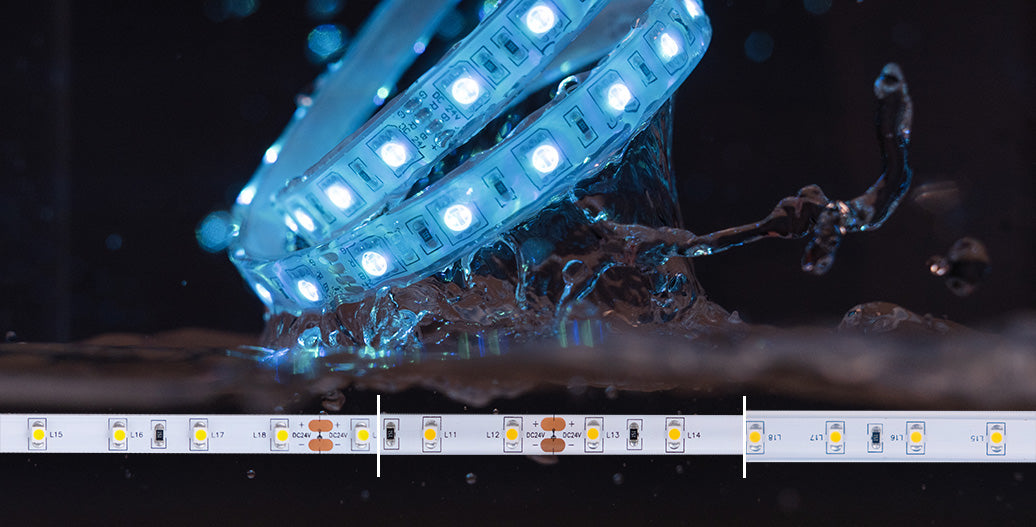

When selecting LED lighting for outdoor, damp, or wet locations, one of the most important specifications to understand is the IP rating.
You may see ratings such as IP20, IP64, IP65, IP67, or IP68 listed on LED strip lights and fixtures. But what do those numbers actually mean, and which IP rating do you need for your application?
This guide explains how IP ratings work, what common ratings mean, and what electricians should consider when installing LED lighting in different environments.
What is an IP Rating?
IP stands for Ingress Protection. An IP rating identifies how well an enclosure protects against solid objects and water under defined test conditions. The system is established by IEC 60529.
An IP rating has two numbers:
- First digit: Protection against solids, including dust
- Second digit: Protection against water
For example, IP65 means the product is dust-tight and protected against water jets.
Common IP Ratings for LED Lighting
| Rating |
Protection Against Solids |
Protection Against Water |
Typical Application |
|
IP20 |
Protection from objects over 12.5 mm | None | Dry indoor locations |
|
IP64 |
Dust-tight | Water splashing from any direction | Damp or some outdoor applications |
|
IP65 |
Dust-tight | Water jets | Outdoor areas exposed to rain |
|
IP66 |
Dust-tight | Powerful water jets | Heavier water exposure |
| IP67 | Dust-tight | Temporary immersion | Areas where temporary submersion may occur |
|
IP68 |
Dust-tight | Continuous immersion under specified conditions | Underwater applications |
These ratings describe specific test conditions. A higher IP number is not automatically better for every installation.
What Does IP65 Mean?
IP65 means the product is dust-tight and protected against water jets from any direction.
IP65 is one of the most common ratings for outdoor LED lighting. It may be appropriate for applications exposed to rain, such as:
- Outdoor accent lighting
- Architectural lighting
- Exterior signage
- Covered patios
- Outdoor entertainment areas
Is IP65 Waterproof?
IP65 should not be interpreted as fully waterproof or submersible. It protects against water jets, but it is not rated for immersion.
If an installation could be temporarily submerged, an IP67 product may be more appropriate. For continuous immersion, look for an IP68 product that is specifically approved for the intended conditions.
What Do IP67 and IP68 Mean?
IP67 provides protection against dust and temporary immersion in water under defined test conditions. It can be appropriate where lighting could become temporarily submerged, but it does not automatically mean the product is designed to remain underwater.
IP68 provides protection against dust and continuous immersion under conditions specified by the manufacturer.
An important distinction is that IP68 does not establish one universal immersion depth or duration. Always check the manufacturer's specifications for the approved depth, duration, temperature, and installation requirements.
What About IP64 and IP66?
IP64 means the product is dust-tight and protected against water splashing from any direction. It does not mean protection from water jets or immersion.
IP66 provides dust-tight protection and protection against powerful water jets.
These ratings are sometimes incorrectly described as simply being "more waterproof" or "less waterproof." Each rating represents different test conditions, so the right choice depends on the environment.
How Do You Choose the Right IP Rating?
Start by identifying what the lighting will actually encounter.
Ask:
Will it be exposed to water?
Determine whether the product will encounter occasional splashing, rain, water jets, or immersion.
Could it become submerged?
If temporary immersion is possible, consider IP67. If the product will remain underwater, look for an IP68 product approved for continuous immersion.
Is the location exposed to other environmental conditions?
IP ratings do not address every environmental factor. Also consider UV exposure, temperature, chemicals, corrosion, condensation, and physical impact.
For many outdoor LED lighting applications exposed primarily to rain, IP65 may be appropriate. However, the installation environment and manufacturer's specifications should always guide the final selection.
Don't Forget the Connections
For electricians, one of the most important considerations is that the LED strip is only one part of the installation.
Connectors, splices, end caps, wire connections, power supplies, and other components must also be appropriate for the environment.
An IP65 LED strip does not automatically make the entire installation IP65. An unprotected connection can become the weak point even when the LED strip itself has a high IP rating.
When installing LED lighting outdoors or in wet locations, consider the protection of the complete system, not just the LED strip. Follow the manufacturer's installation instructions and use components rated for the intended environment.
IP Ratings vs. NEMA Ratings
IP ratings and NEMA ratings are not interchangeable.
IP ratings primarily address protection against solid objects and water. NEMA enclosure ratings consider these factors along with additional characteristics, such as corrosion, icing, oil, and construction requirements.
If a project specification calls for a particular NEMA enclosure type, follow the applicable NEMA requirements rather than assuming an IP rating is equivalent.
Frequently Asked Questions
What does IP65 mean?
IP65 means the product is dust-tight and protected against water jets from any direction.
Is IP65 waterproof?
IP65 provides protection against water jets, but it is not rated for immersion.
What is the difference between IP65 and IP67?
IP65 protects against water jets, while IP67 protects against temporary immersion. They address different types of water exposure.
Is IP68 waterproof?
IP68 provides protection against continuous immersion under manufacturer-specified conditions. The approved depth and duration can vary by product.
What IP rating is best for outdoor LED lighting?
For many outdoor applications exposed to rain, IP65 may be appropriate. Applications involving temporary or continuous immersion may require IP67 or IP68.
Does a higher IP rating mean better protection?
Not necessarily. The right IP rating depends on the actual installation environment. A higher rating is not automatically necessary or better for every application.
To Conclude
Understanding IP ratings helps electricians select LED lighting that is appropriate for the installation environment.
Remember:
- The first digit indicates protection against solids.
- The second digit indicates protection against water.
- IP65 protects against water jets but not immersion.
- IP67 protects against temporary immersion.
- IP68 protects against continuous immersion under specified conditions.
- A higher IP rating is not automatically better.
- Connections and other components need to be appropriate for the environment too.
- UV, temperature, chemicals, corrosion, condensation, and physical impact should also be considered.
When selecting LED lighting, match the IP rating to the conditions the product will actually encounter, and always review the manufacturer's specifications and installation requirements.


