

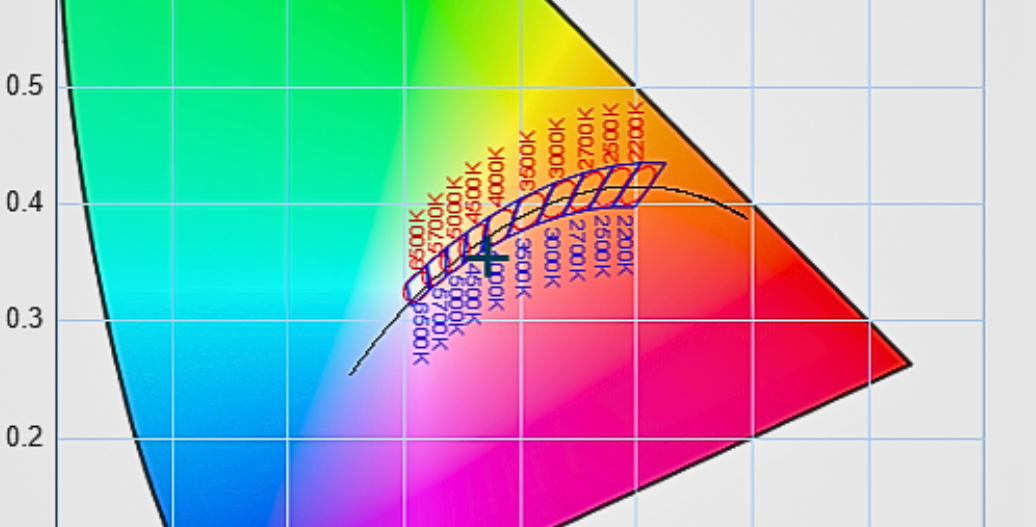

When choosing LED lighting, you'll often compare specifications like 2700K, 3000K, 4000K, or 90+ CRI. These numbers help describe the quality and appearance of the light, but they don't tell the whole story.
If two LED lights are both 3000K with a 90+ CRI, shouldn't they look exactly the same?
Not always.
While color temperature and CRI are important, there's another factor that affects the appearance of white light: the black body curve. Understanding how these three measurements work together can help you choose lighting that looks more natural and performs better, whether you're designing a kitchen, specifying products for a customer, or installing lighting on the job.
At aspectLED, our Chroma RGBW LED Strip Light Kit utilizes white LEDs engineered to closely follow the black body curve. The result is premium white light for everyday use, along with vibrant RGB color whenever you want it.
What is the Black Body Curve?
The black body curve, also known as the Planckian locus, is a scientific reference that describes how a theoretical heated object emits light.

Natural light sources, including sunlight and incandescent bulbs, closely follow this curve. Because our eyes are accustomed to these light sources, LEDs that closely follow the black body curve produce white light that appears more natural and balanced.
Black Body Curve vs. Color Temperature
One of the biggest misconceptions in lighting is that color temperature tells you everything about the appearance of white light.
It doesn't.
Color temperature only tells you which shade of white the light is intended to produce.
The black body curve tells you how accurately that shade of white is reproduced.
| Color Temperature (Kelvin) |
Black Body Curve |
| Describes whether light appears warm or cool. | Describes how closely white light matches natural white light. |
| Measured in Kelvin, such as 2700K, 3000K, or 4000K. | Measured by how closely the LED follows the Planckian locus. |
| Helps you choose the desired white light color. | Helps determine whether that white light looks clean, balanced, and natural. |
A Real World Example
Imagine you're remodeling a kitchen.
You install new 3000K under cabinet LED strip lights beneath your cabinets. Your recessed ceiling lights are also rated at 3000K.
On paper, everything should match.
But when you turn the lights on, the under cabinet lighting has a slight green tint while the recessed lights appear more neutral. The difference isn't dramatic, but it's enough that the two fixtures don't quite blend together.
Both products have the same Kelvin rating.
The difference is that one follows the black body curve more closely than the other.
For electricians and contractors, it can mean additional troubleshooting or customer questions, even when the installation was done correctly. For homeowners, this can make a finished project feel less polished.
Black Body Curve vs. CRI
Another specification that's often confused with the black body curve is CRI, or Color Rendering Index.
Although both contribute to lighting quality, they measure completely different characteristics.
| CRI (Color Rendering Index) |
Black Body Curve |
| Measures how accurately a light source reveals the colors of objects. | Measures how natural the white light itself appears. |
| A higher CRI helps paint, wood, fabrics, and food look more true to life. | A closer match to the black body curve helps white light look balanced and consistent. |
Think of it this way:
- Color temperature tells you whether the light is warm or cool.
- The black body curve tells you whether that white light looks natural.
- CRI tells you how accurately the light reveals the colors of the objects around it.
Each measurement answers a different question.
An LED can have a 90+ CRI and still produce white light with a slight green or pink tint if it doesn't closely follow the black body curve. Likewise, an LED can closely follow the black body curve but have a lower CRI, meaning colors won't appear as vibrant or accurate.
The highest quality LED lighting performs well in all three areas.
Why It Matters for LED Strip Lighting
LED strip lights are commonly installed in locations where people see the light directly, such as:
- Under cabinets
- Shelving
- Display cases
- Cove lighting
- Architectural accents
Because these applications highlight the light itself, even subtle differences in white light become more noticeable.
That's why aspectLED designed the Chroma RGBW LED Strip Light Kit with white LEDs that closely follow the black body curve.
This helps deliver white light that:
- Looks clean and natural
- Blends better with recessed lighting and other fixtures
- Reduces unwanted green or pink tint
- Creates a more refined, professional-looking installation
While Chroma offers vibrant RGB colors for accent and decorative lighting, many consumers spend the majority of their time using the dedicated white LEDs. Investing in higher quality white light improves the look and feel of the space every day.
Better White Light Starts with Better Engineering
Color temperature and CRI are important specifications, but they only tell part of the story. The black body curve explains why two LED products with the same Kelvin rating and similar CRI can still produce noticeably different white light.
By engineering LEDs that closely follow the black body curve, we can create lighting that appears more natural, blends better with other fixtures, and delivers a more consistent finished result.
The aspectLED Chroma RGBW LED Strip Light Kit was designed with this level of performance in mind, providing premium white light for everyday use along with vibrant RGB color when you want to transform a space.
If you're looking for LED strip lighting that goes beyond the basic specifications, explore the Chroma RGBW LED Strip Light Kit to experience the difference for yourself.
If you're an electrician, contractor, builder, or lighting designer, join the aspectLED Pro Program for exclusive pricing, project support, and resources that help you deliver exceptional lighting on every installation.


