

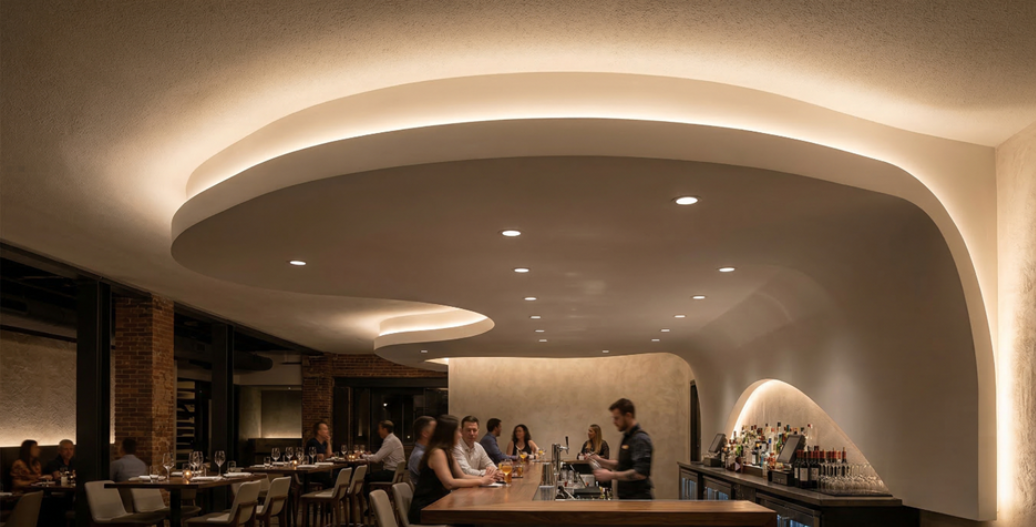

In the fast-paced restaurant industry, lighting serves as the silent host that shapes the entire dining experience. Whether you are designing an intimate, high-end dining room or a high-volume, fast-casual coffee shop, the ceiling architecture dictates exactly how light interacts with the space. For electricians, contractors, builders, and designers, the ultimate goal is executing these architectural lighting features quickly, profitably, and beautifully.
Today, we are going to break down the ceiling structures used to create dramatic, layered lighting in commercial spaces. Specifically, we will explore why moving away from floating elements and embracing a finished curved bulkhead is the smartest choice for a seamless, headache-free commercial installation.
Defining the Space: Floating Clouds vs. Framed Bulkheads
When designers want to bring the ceiling plane down to create intimacy over a specific dining zone or highlight a bustling barista counter, they generally choose between two architectural structures.
The Suspended Cloud (or Canopy Raft): A "cloud" is a floating ceiling element suspended below the primary structural ceiling, typically hung by thin aircraft cables. It creates a modern, airy aesthetic. However, suspended clouds present a unique logistical challenge for the installing electrician: hiding the power. Because the structure literally floats, routing rigid conduit or standard line-voltage wiring down to the unit can ruin the clean, minimalist aesthetic. Installers are forced to run low-voltage wiring down the suspension cables themselves, which requires meticulous planning, precision, and ultimately slows down the installation process.
The Sweeping Ceiling Bulkhead: If you’ve ever walked into a modern cafe and admired the seamless, dropping curves over the espresso machines, you are looking at a curved restaurant bulkhead. Unlike a floating cloud, a bulkhead is a completely built-in, finished structure framed down directly from the ceiling above. It has no floating gap. It acts as a massive, hollow cavity rigidly framed with metal or wood studs and finished with drywall or flex-board to create those organic, flowing shapes.
For a commercial dining environment, a finished curved bulkhead often features a light cove: a recessed inner lip designed specifically to hide linear LED lighting that washes a soft, indirect glow up onto the ceiling or cascades down a textured wall.
Why the Curved Architectural Soffit is an Installer’s Best Friend
From an installation perspective, a sweeping ceiling bulkhead completely changes the game. This is especially true if you are managing a crew where the primary installing electrician might be on the unexperienced side.
Because a curved restaurant bulkhead is a fully framed structure rather than a floating object, it behaves exactly like a standard hollow wall. There are no exposed suspension cables to carefully dress with wire. Pulling wire through the framing to power linear LED strips along the organic curves or popping in standard recessed downlights is incredibly straightforward and forgiving.
More importantly, the massive internal cavity of a curved architectural soffit solves the biggest headache in modern commercial lighting: where to put the power supplies and controls.
The 24-Volt DC, Class 2 Advantage
Commercial restaurant lighting demands a high-quality feel, smooth dimming, and absolute day-to-day reliability. The most effective way to achieve this in a finished curved bulkhead is by utilizing a 24 volt DC, Class 2 LED system.
Running Class 2 low-voltage wiring through a commercial bulkhead is fast, safe, and easily complies with NEC standards without the need to run rigid line-voltage conduit to every single fixture location. You can route your 24 volt wiring cleanly to the exact spots where your linear tape light will sit inside the coves.
You also want a system that gives you the freedom to use the best parts for the job, regardless of who makes them. The beauty of a 24V DC system is the ability to mix and match. You can pair high-quality, universal power supplies with the specific linear LED strip lights required for the job, rather than being locked into a single, restrictive ecosystem that limits your options down the road.
Mastering the Controls: Simplicity and the User Experience
A lighting system is only as good as the user experience it provides to the restaurant manager at the end of a chaotic shift. A user interface that puts the customer at risk with bad software, frequent disconnects, or a confusing app is an absolute non-starter in a fast-paced commercial environment.
When evaluating and specifying controls for a sweeping ceiling bulkhead, you should prioritize a few key areas:
- Simplicity of installation
- A premium aesthetic
- Serviceability
Stick to proven wireless protocols that boast high app update frequencies and rock-solid reliability. Systems like Casambi rate exceptionally high because they do these things incredibly well.
When you use a finished curved bulkhead design, you can easily tuck these reliable wireless controls and standard 24 volt power supplies safely inside the ceiling cavity. They remain completely out of sight to preserve the room's aesthetic, but stay easily accessible for future maintenance through a small access panel or by simply popping out an adjacent recessed light fixture.
Achieving the Perfect Aesthetic
Once the framing is up and the 24 volt power is run, the final step is ensuring the light itself looks flawless. In a curved restaurant bulkhead, the goal is a seamless, uninterrupted wash of illumination.
Always use mounting channels with frosted diffusers for your linear LED strips. This acts as a heat sink to protect the tape and prolong its lifespan, while also ensuring that the light reflecting off the ceiling is smooth and continuous, eliminating the harsh look of individual LED hotspots. Combined with a quality feel from the control interface, the resulting aesthetic elevates the entire dining experience.
By leveraging the structural benefits of a curved architectural soffit, standardizing on a Class 2 24 volt DC infrastructure, and utilizing reliable controls, you can execute a stunning commercial lighting package that goes in quickly and operates flawlessly for years.
Partner with the Pros at aspectLED
Are you ready to elevate your next commercial restaurant build? At aspectLED, we specialize in high-quality linear LED strip lights, power supplies, and aluminum channel systems designed for seamless commercial installation. We make it easy to mix and match the exact components you need to build a flawless, reliable 24 volt system that your customers will love.
Contractors, Electricians, Builders, and Designers: Maximize your margins and streamline your sourcing by joining the aspectLED Pro Program. Get exclusive access to special pricing, dedicated project support, and the highest quality LED lighting products on the market. Source your linear LED strip lights from aspectLED and check out our Pro Program today.


