

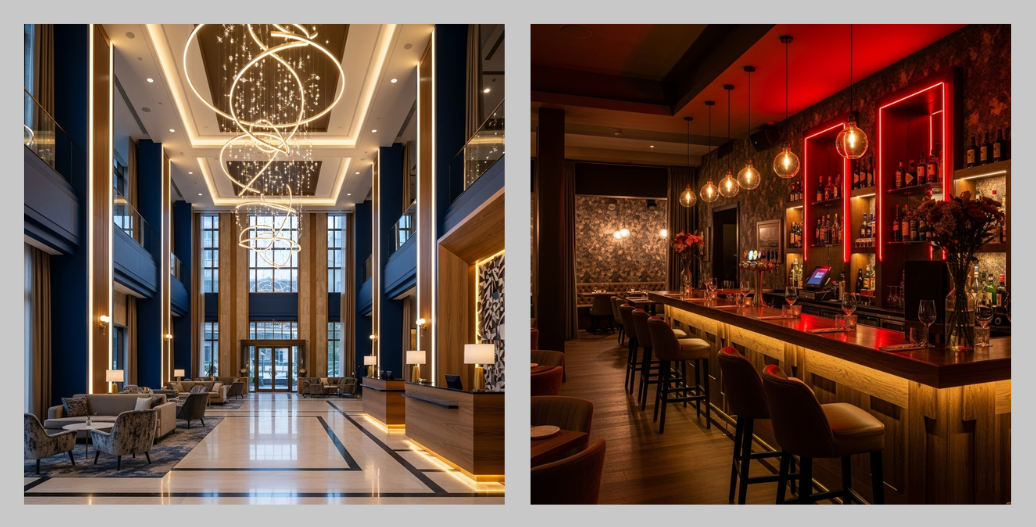

Hotels and restaurants run their lights longer than almost any other commercial space. Guest rooms, hallways, kitchens, dining rooms, bars, and exteriors all stay lit for long stretches of the day and often around the clock. Those extended operating hours are exactly why LED lighting delivers outsized savings in hospitality compared to offices, retail, or residential spaces.
When lights are on for 12 to 18 hours per day or even 24 hours in some areas, small efficiency gains add up fast. That is when LEDs start paying for themselves.
The Math: Why Hospitality Sees Bigger Savings
One simple way to understand lighting efficiency is luminous efficacy. This measures how much light you get per watt of electricity.
A traditional incandescent lamp produces roughly 16 lumens per watt. A typical LED fixture produces about 100 lumens per watt. When you divide 100 by 16, LEDs are more than six times as efficient at converting electricity into usable light.
That difference matters in a home where lights are used a few hours in the morning and evening. It matters far more in hospitality settings where fixtures stay on most of the day.
In a hotel or restaurant, it is common for lights to run 12 to 18 hours per day. In some locations like hallways, stairwells, lobbies, and kitchens, lights may be on 24 hours a day for safety and operations. The longer the runtime, the faster inefficient lighting drains energy dollars.
Switching from incandescent or halogen fixtures to LED lighting cuts wattage dramatically while maintaining or improving light output. Over thousands of hours each year, those wattage reductions translate directly into lower utility bills.
Beyond Energy: The Full ROI Picture
Energy savings are only one part of the return on investment.
Another major advantage of LEDs is lifespan. Incandescent bulbs often last between 1,000 and 2,500 hours. In contrast, most commercial LED products are rated for 50,000[MR1.1] hours of use. 50,000 hours is the industry standard, however, variable conditions can affect the life of the product. Even as LEDs start to reach their rated lifespan, they typically continue operating at reduced brightness rather than failing outright.
For hospitality operators, this changes the maintenance equation completely. A light that runs eight hours per day reaches about 2,000 hours in a year. With incandescent lamps, that means annual replacements. With LEDs, that same fixture can run for many years without attention.
Maintenance savings go beyond the cost of bulbs. Labor, lifts, guest disruption, and safety concerns all add cost when staff need to replace fixtures in occupied spaces. Fewer replacements mean fewer interruptions to guests and staff.
LEDs also produce far less heat than incandescent lighting. Lower heat output reduces strain on HVAC systems, especially in kitchens, dining rooms, and lobbies with high lighting density. Over time, that can contribute to additional energy savings beyond lighting alone.
Finally, lighting quality matters in hospitality. Better lighting improves visibility, comfort, and ambiance. That affects guest experience, reviews, and repeat business. LEDs offer consistent color temperature, higher color rendering, and better control options compared to older technologies.
Hotels vs. Restaurants: Different Spaces, Same Benefits
While hotels and restaurants use lighting differently, both benefit from LED upgrades in key areas.
Hotel Applications
Effective hotel lighting requires balancing guest comfort, safety, aesthetics, and energy efficiency. Here are some of the areas where LED lighting provides the greatest impact.
Hallways and stairwells
These areas require constant illumination for safety and code compliance. Motion sensors are not always appropriate, which makes efficiency critical. LED fixtures and linear lighting dramatically reduce energy use in these always on spaces.
Guest rooms
Tunable white LED lighting allows hotels to adjust color temperature for comfort and relaxation. Warm light in the evening and cooler light during the day improves the guest experience. Tunable white LED strip lights work well for coves, headboards, and indirect lighting.
Lobbies and common areas
High visibility spaces operate long hours and set the tone for the property. LEDs provide consistent brightness, reduced heat, and lower maintenance in areas that are often difficult to access.
Exterior and parking areas
Exterior LED lighting improves security while reducing energy costs. Long lifespan is especially valuable in pole mounted and hard to reach fixtures.
Restaurant Applications
Restaurant lighting presents a unique challenge. While LEDs are far more efficient than incandescent lighting, food presentation requires excellent color quality.
Incandescent light naturally produces a full spectrum that makes food look rich and appealing. Poor quality LEDs can struggle with red tones, causing food to appear dull or washed out. That is why high CRI and TM-30 rated LED products are critical in dining environments.
High CRI LED strip lights with strong red rendering ensure that meats, sauces, and produce look vibrant and natural under LED lighting.

Dining areas
LEDs support layered lighting designs that balance ambiance and functionality while maintaining accurate color for food presentation.
Kitchens
Commercial kitchens benefit from LED task lighting that handles heat, moisture, and long operating hours. NSF Certified LED Fixtures and Products for Food Safety are approved for use near food prep areas and are designed for durability and cleanliness.
Bar areas
Accent lighting and RGB strip lights allow restaurants to create atmosphere and visual interest while keeping energy use low.
Signage and exterior
LEDs improve brand visibility while reducing operating costs for signs, patios, and building exteriors.
Making the Business Case: What to Calculate
Building an ROI case for LED lighting does not require complex modeling. A few key inputs usually tell the story.
Start with current wattage versus LED wattage. For example, a typical hotel lobby may require around 30,000 lumens. An incandescent system might draw roughly 2,250 watts to achieve that output, while an LED system could deliver the same light using only 300 to 450 watts.
Next, calculate daily operating hours. Lobbies, hallways, and kitchens often run 12 to 24 hours per day.
Multiply by the number of fixtures and your local electricity rate to estimate annual energy costs.
Then factor in lifespan. An LED solution rated for 50,000 hours can last 25 to 50 times longer than incandescent lamps. That drastically reduces replacement frequency and labor costs, especially in hard-to-reach spaces.
When installation cost is weighed against annual energy and maintenance savings, many hospitality projects see payback periods between two and five years. After that point, the savings go straight to the bottom line.
FAQs
How much can hotels save by switching to LED lighting?
65-80% energy savings typical, with payback in 2-5 years.
What's the payback period for LED lighting in restaurants?
2-3 years is typical due to long operating hours.
How long do LED lights last in commercial applications?
50,000 hours is the industry standard, however, variable conditions can affect the life of the product. A typical LED can last for years of operation before replacement.
Are there utility rebates for LED lighting upgrades?
Many utilities offer incentives. Check local programs.
Save on Power and Maintenance Without Sacrificing Quality
LED lighting helps hospitality businesses lower operating costs while improving the guest experience. From tunable white guest rooms to high CRI dining areas and NSF rated kitchen lighting, the right LED products deliver both efficiency and performance.
If you are planning a restaurant or hotel project, aspectLED can help you select lighting solutions that balance energy savings, longevity, and visual quality.
Trade professionals working on multi location projects can also take advantage of contractor pricing through aspectPRO.


