

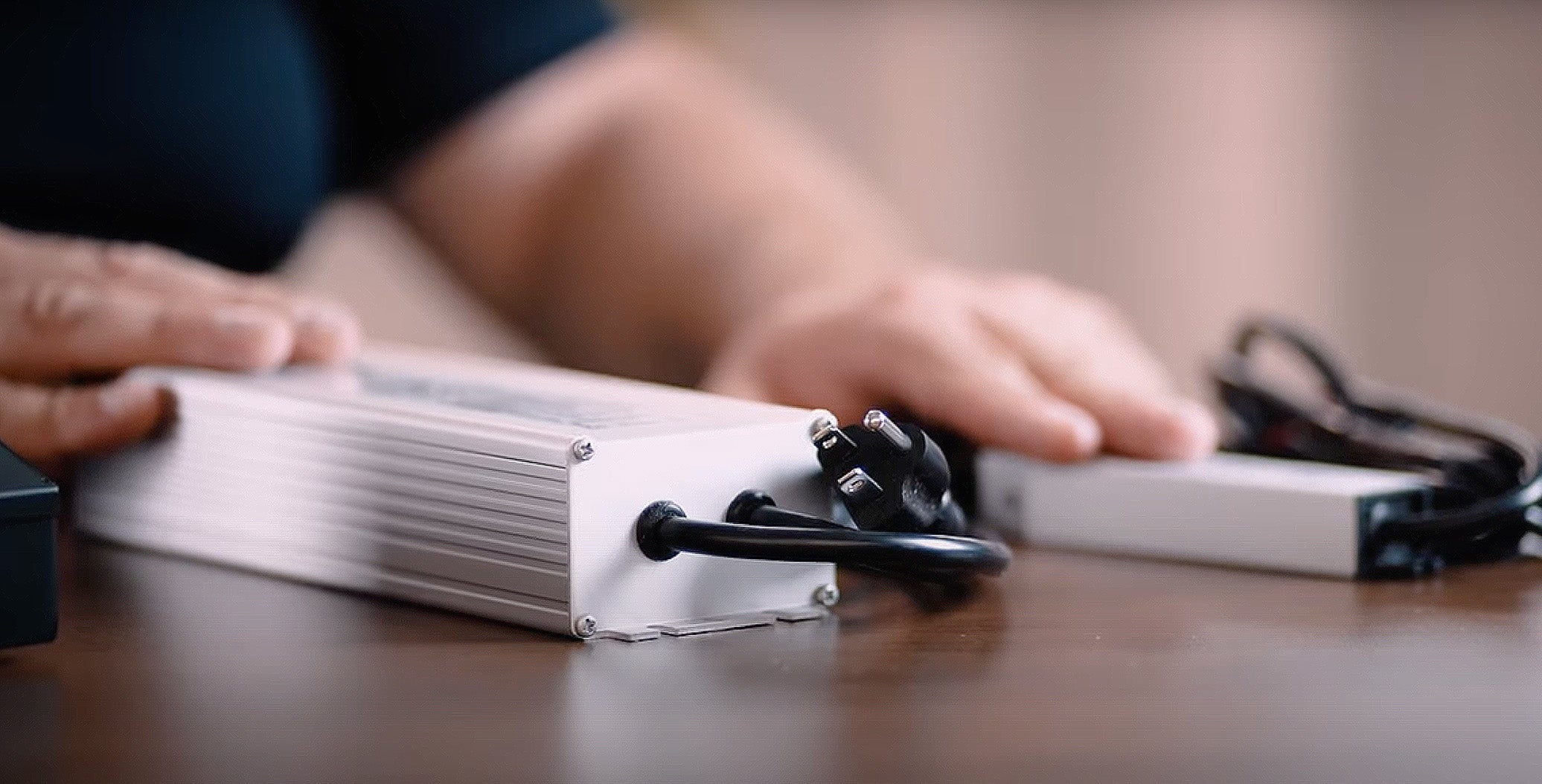

Choosing the correct size power supply is critical for ensuring optimal LED lighting efficiency and system performance. Proper sizing helps prevent issues associated with both undersized and oversized power supplies. An important consideration in this process is determining whether the system will use AC line-side dimming, low-voltage DC dimming, or no dimming at all. This decision directly impacts whether you need a dimmable or non-dimmable power supply, which in turn affects sizing requirements. This article focuses primarily on non-dimmable LED power supplies, which provide a consistent DC output and are ideal for setups using external DC-side dimmers or controllers. Understanding voltage requirements and selecting the appropriate power supply is key to maximizing efficiency and system longevity.
Understanding Power Supply Basics
What is a Power Supply?
A power supply is a device that converts line voltage, 120VAC (Volts Alternating Current), into low-voltage, typically 12/24 VDC (Volts Direct Current), needed to properly operate most LED lights. This ensures they receive the correct current and voltage to function optimally without damage.
What is the Difference between a Driver, Power Supply, and a Transformer?
A driver limits the current and voltage for a single light fixture, ensuring that the individual LED fixture receives the appropriate amount of power without exceeding its limitations.
- An example of an LED driver is the small metal box included with our 120VAC recessed and ultra-thin lights. For instance, our 3.5-inch ultra-bright recessed light comes with a 600-milliamp driver housed inside a metal junction box. This driver regulates and limits the current to the light, ensuring it receives a consistent 600 milliamps for safe and efficient operation.
A power supply maintains a constant voltage, such as 12 volts DC or 24 volts DC, allowing for the addition of multiple lights. Each power supply has a specific wattage output capacity. The size of the power supply required for your project will be determined by the total wattage of the lights (or load) being connected to the power supply.
- An example of a power supply would be the 100-Watt DC power supply. It's generally recommended to load power supplies to around 80% of their maximum capacity for optimal performance and longevity. Unlike LED drivers, power supplies don't regulate current, so it's possible to connect a significantly smaller load without causing issues—though efficiency and system design should always be considered.
A transformer simply transforms voltage down to a specified level. Since power supplies and drivers both transform voltages (albeit to different levels), they are both technically transformers. The term transformer is more commonly used when referring to the power supply in a low voltage AC system.
- An example of a low-voltage transformer is the Magnitude Otter, commonly used for landscape lighting. It outputs 12 volts AC, meaning it delivers an alternating current with a sine wave rather than a flat, constant current. Because of this, it's only compatible with certain types of lights. If you're planning to use this type of transformer, it's important to ensure that the connected lights are specifically rated for 12 volts AC power to avoid performance issues or damage.
Key Safety Consideration
When selecting the correct size power supply for your LED lighting system, it’s also important to consider whether the application requires compliance with Class 2 standards. Defined by the National Electrical Code (NEC), a Class 2 power supply is limited to 60 volts DC, 4 amps, and 100 watts (typically 48 watts at 12V or 96 watts at 24V). These limitations are designed to reduce the risk of shock and fire, making Class 2 circuits inherently safer and often easier to install without special permitting or high-voltage precautions. Many lighting systems—especially those used in residential, outdoor, or wet-location settings—require or recommend Class 2 power supplies for code compliance and product compatibility. When sizing your power supply, staying within these Class 2 limits can help ensure both safety and adherence to local electrical codes.
The Risks of Choosing a Power Supply that is Too Small
- Flickering and Dimming: Insufficient power can cause unstable lighting performance.
- Reduced LED Lifespan: LEDs may wear out faster when underpowered.
- Overheating and Safety Hazards: Overloading a power supply increases the risk that it will overheat and potentially fail.
- Shutdowns and Strobing: Exceeding 100% capacity can cause the power supply to shut off and attempt to restart, leading to on/off strobing effects.
- Increased Wear on Protection Circuitry: Overloading a power supply can wear out the internal protection mechanisms over time, causing more frequent failures.
Best Practice:
- Stay Within 80% Load: For optimal efficiency and longevity, only load your power supply to 80% of its rated capacity. This helps it run cooler and more reliably.
The Downsides of a Power Supply that is Too Large
- Higher Upfront Cost: Larger power supplies are more expensive, adding unnecessary cost to your project.
- Reduced Efficiency: Oversized units often operate less efficiently under low loads, wasting energy.
- Bulkier Size: Bigger power supplies can be harder to install, especially in tight or concealed spaces.
- Minimum Load Requirements: Many power supplies, especially dimmable power supplies, require a minimum load to function properly. For example, a 200-watt supply might need at least 10 watts connected. Without enough load, lights may flicker or behave erratically.
Best Practice:
- Check the Specs: Always verify that your power supply matches your LED system’s actual power consumption.
- Choose the Right Size: A properly sized power supply ensures better efficiency, fewer issues, and more reliable lighting performance.
When Bigger Might Be Better
- Future-Proofing and Scalability: If you plan to expand your LED setup in the future, a slightly larger power supply can save you from having to replace it down the line. This makes upgrades easier and more cost-effective.
- Cooler Operation and Better Thermal Management: Power supplies tend to run cooler and more efficiently when operating at partial load, which can improve performance and longevity.
That said, it’s all about balance. If you're unsure whether your current power supply is close to its limit, it’s usually a good idea to size up—but not excessively. There’s no benefit to overspending on capacity you’ll never use. You don’t want to waste money, energy, or space with an oversized unit that doesn't match your needs.
Tips for Choosing the Right Size Power Supply
Check Voltage Compatibility
Match the power supply output voltage to the LED input voltage. The two most common power supply output voltages are 12VDC and 24VDC. It’s essential to ensure that the voltage of the power supply matches the voltage requirements of the LED system you’re using.
Calculate Total Wattage
The wattage listed for each power supply is its maximum capacity. At aspectLED, our power supplies are designed to run at 80% of their rated wattage for continuous use. To avoid overloading, calculate the total wattage of your LED load, then choose the power supply that has at least 20% higher capacity. A simple rule of thumb: Multiply your total LED wattage by 1.25, then round up to the next available power supply size.
- Example: If your LED load is 65 watts, multiply by 1.25 to get 81.25 watts. The next standard power supply size above that would be 100 watts, making it the correct choice.
- The power supply calculator linked on our product pages is a great resource for quick and accurate sizing.
Consider Environment
When installing a power supply, be sure to account for heat, moisture, and ventilation needs. Power supplies are typically rated for temperature ranges between -40 °F and 122°F. Also, per NEC guidelines, you should maintain approximately 3 inches of clearance on all sides, as well as above and in front of the power supply for proper airflow.
To Conclude
Choosing the correct power supply is essential for safe, efficient, and long-lasting LED system performance. Always ensure the power supply is appropriately sized for your LED load to prevent issues like overheating or early failure. For the best results, consult a lighting professional or refer to the manufacturer's specifications to guide your selection. Keeping safety and performance in mind will help you achieve a reliable LED system design. Shop all LED power supplies
Need Help?
Whether you're troubleshooting an existing setup or planning a future LED lighting upgrade, our experts at aspectLED are here to help. Contact our Tech Support team at support@aspectled.com or 844-979-3564 for guidance—we’ll make sure you get the right power supply for your project, both now and as it grows.


